Making Memories: How Learning Sticks
Learning is how memories are made, and memory is how learning sticks in our minds. The science behind these processes can be complicated, but that’s where this blog post comes in.
In this post, we’ll explore the concept of learning and memory, figure out what exactly is going on in our heads, and hope that we learn something by the end of it.
What does it mean to learn?
Learning is the ability to change behaviour based on past experiences, and can be split across three categories.
Simple (non-associative) learning is all about repeated encounters, or a lack of association. For example, safari animals can learn to ignore tourist vans (an example of habituation, or repeated safe encounters), and a dripping faucet gradually gets more and more annoying (an example of sensitisation).
Associative learning happens when a connection is formed between two stimuli, such as an event and a reward. There are two types: classical conditioning and operant conditioning.
Classical conditioning is the association of two stimuli that occur closely together. A well-known example of this is Pavlov’s dog, where Ivan Pavlov discovered that dogs can be trained to associate a neutral stimulus (the ringing of a bell) with food (the reward), which eventually led to the dog salivating at just the sound of the bell in the anticipation of food. Coincidentally, Pavlov must have also conditioned himself into feeding his dog every time he heard a bell ring.
Operant conditioning is the association of a voluntary behaviour with a consequence (either reinforcement or punishment).
Positive reinforcement (Getting a raise for good job performance, adding a pleasant stimulus to increase behaviour)
Negative reinforcement (putting a seatbelt on to stop your car from making that annoying alarm sound, removing an unpleasant stimulus to increase behaviour)
Positive punishment (receiving a fine for speeding, adding an unpleasant stimulus to decrease behaviour)
Negative punishment (taking a child’s toy for misbehaving, removing a pleasant stimulus to decrease behaviour)
Complex learning involves memory retention, conscious evaluation and a change in the structure of neurons (which we’ll cover in just a second, so remember this!).
What exactly is a memory?
Memory is the ability to store and recall experiences. Everything we perceive is momentary, unless the information is captured, stored, and recycled by the nervous system.
There are four types of memory:
Immediate: a sense of the present, or what is immediately happening (perception)
Working: stores information for short periods and actively processes it for immediate use, like following instructions or doing mental maths (decision-making)
Short-term: stores information briefly, like remembering your hotel room number
Long-term: stores information for long periods (days to an entire lifetime) and can be recalled, such as remembering your own name
But what’s happening in our brains?
To make sense of learning and memory, we need to understand how our brains work on a cell level, and this starts with our neurons and synapses.
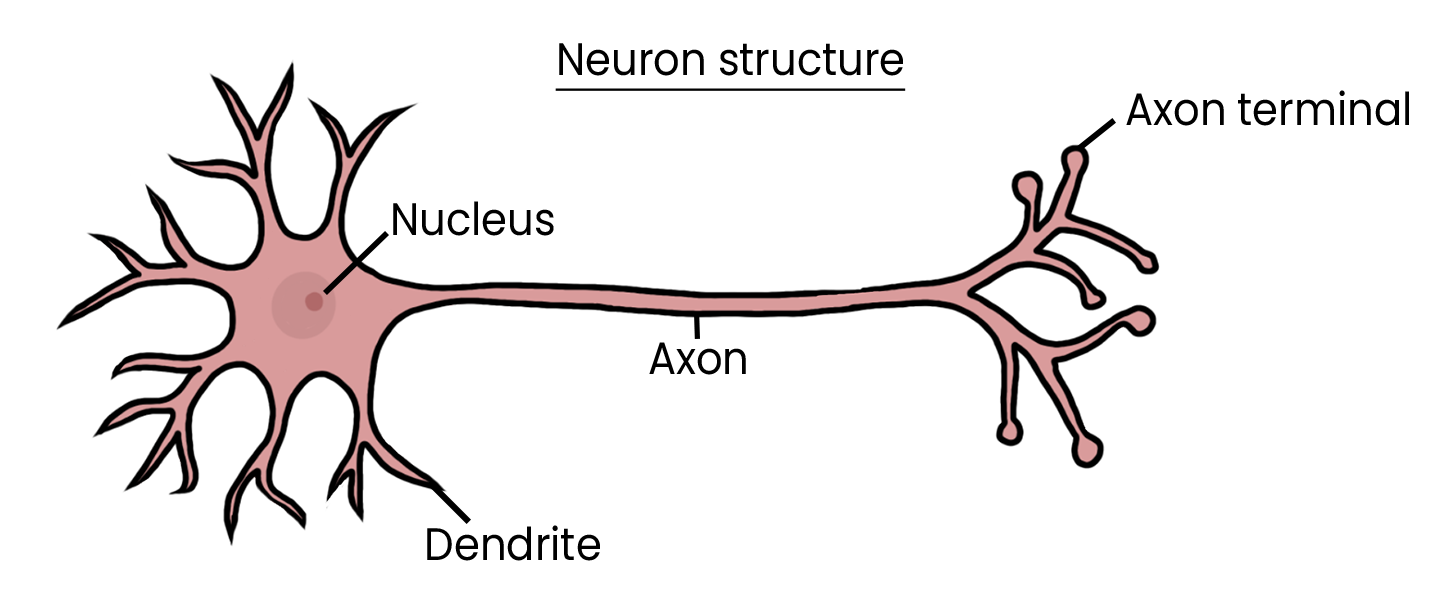
Neurons are cell types that act like wires to transmit information. These ‘wires’, when grouped together, are nerves, and they form a network (the nervous system) that travels from the body, up the spinal cord, and into the brain. Neurons receive sensory input, process the information, and send signals to coordinate a response. These signals are electrical (called action potentials), and pass from the dendrite along the axon and to the axon terminal.
The gap between neurons is called a synapse, and impulses shift from electrical to chemical as they cross this gap from the pre-synaptic neuron to the post-synaptic neuron. The chemicals that cross the synapse are known as neurotransmitters, and they bind to receptors on the post-synaptic neuron, which allows the impulse to shift back to electrical and flow along another neuron, so the process can repeat. Without neurotransmitters, the impulse wouldn’t be able to go very far at all.
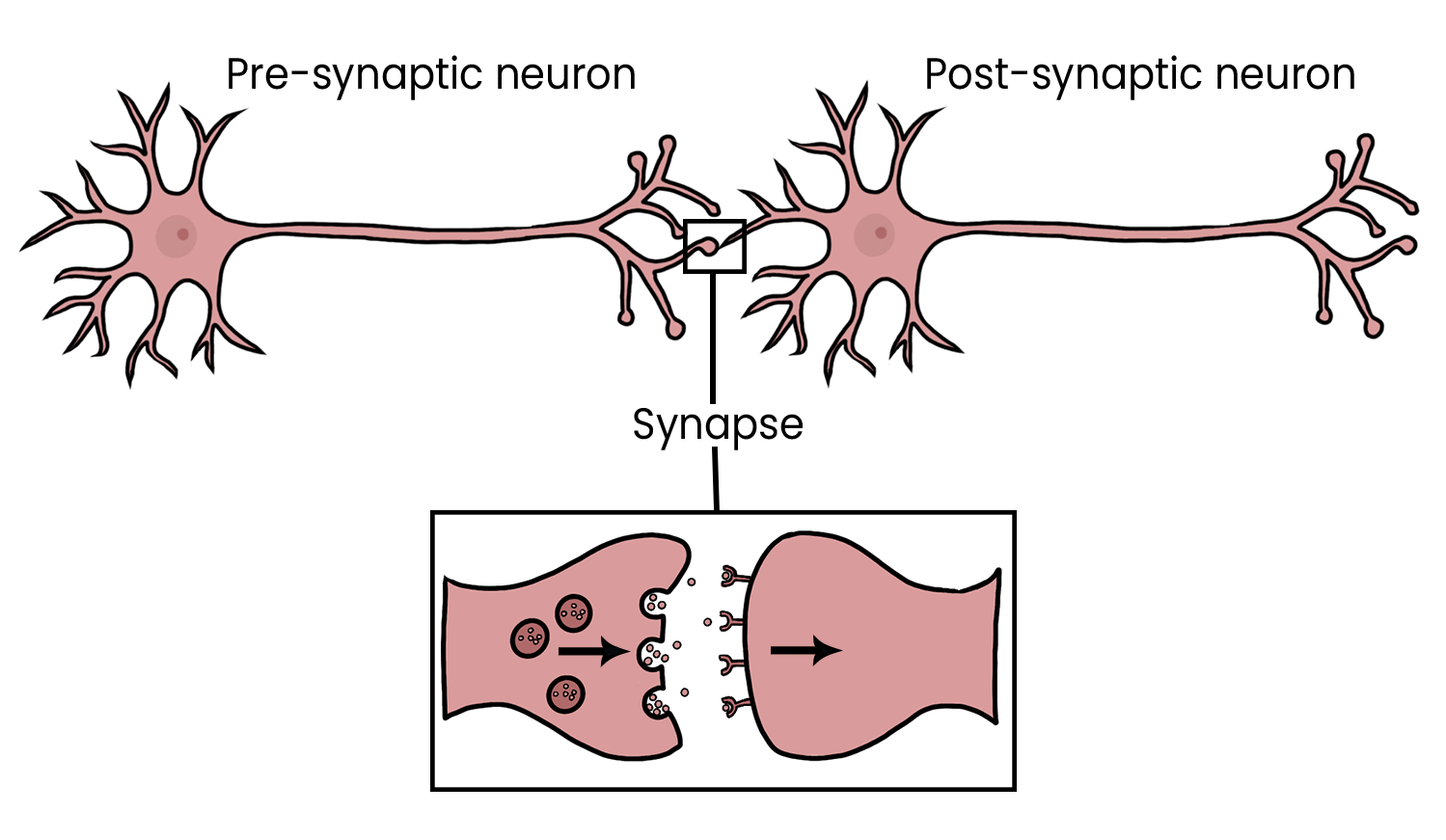
Changes that happen to these neurons, especially at the synapse, form the basis of memory.
Think of a memory as one of those electrical impulses travelling along your neurons to your brain. The path that impulse takes has to be maintained in order for the memory to be retrieved again. Working and short-term memory are held in existing neuron pathways that are fragile and don’t last long, but long-term memory involves restructuring the neuron to make the impulse stronger, and therefore easier to retrieve.
Synaptic plasticity is the complex term for this process, but all it means is that the chemicals (neurotransmitters, remember?) crossing the synapse form stronger connections based on recent patterns of activity. The stronger the connection, the more easily the memory can be recalled, and the longer it lasts (AKA long-term instead of short-term memory).
Let’s look at this in a bit more detail for both short-term and long-term memory.
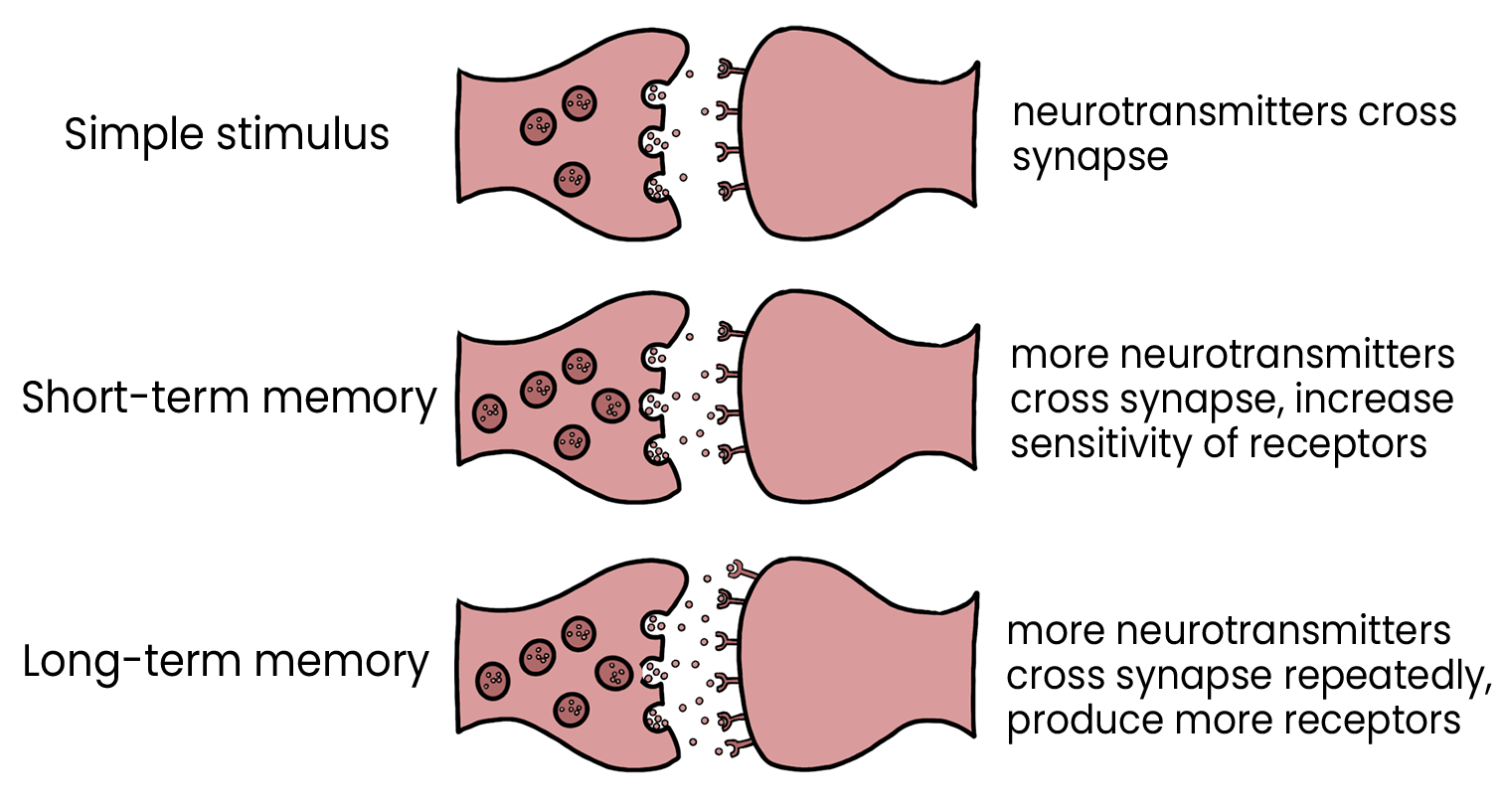
Short-term memory:
Changes are pre-synaptic, meaning they occur on the neuron before the synapse only. More neurotransmitters are produced and transported to the axon terminal, and existing receptors are altered to temporarily make a synapse more sensitive to future signals. As it relies on temporary changes in neurotransmitter levels and receptor sensitivity, the effect decays within minutes to hours if not repeated. The effect is, therefore, short-term.
Long-term memory:
Long-term memory involves several processes. Not only is there an increase in neurotransmitters, as seen in short-term memory, but the repeated stimulus allows these neurotransmitters to travel to the neuron’s nucleus where more structural proteins are produced. These proteins form permanent synapse connections (more receptors), turning a temporary pathway into a permanent structure, and making it a lot easier for future signals to pass through. The changes are both pre-synaptic and post-synaptic and the effects take longer to degrade, if at all. Therefore, the effect is long-term.
Remember the three types of learning from earlier? Here is how they are connected to memory:
Simple and associative learning involve unconscious processes and use implicit memory (short-term). Complex learning is a conscious process that uses explicit memory (long-term).
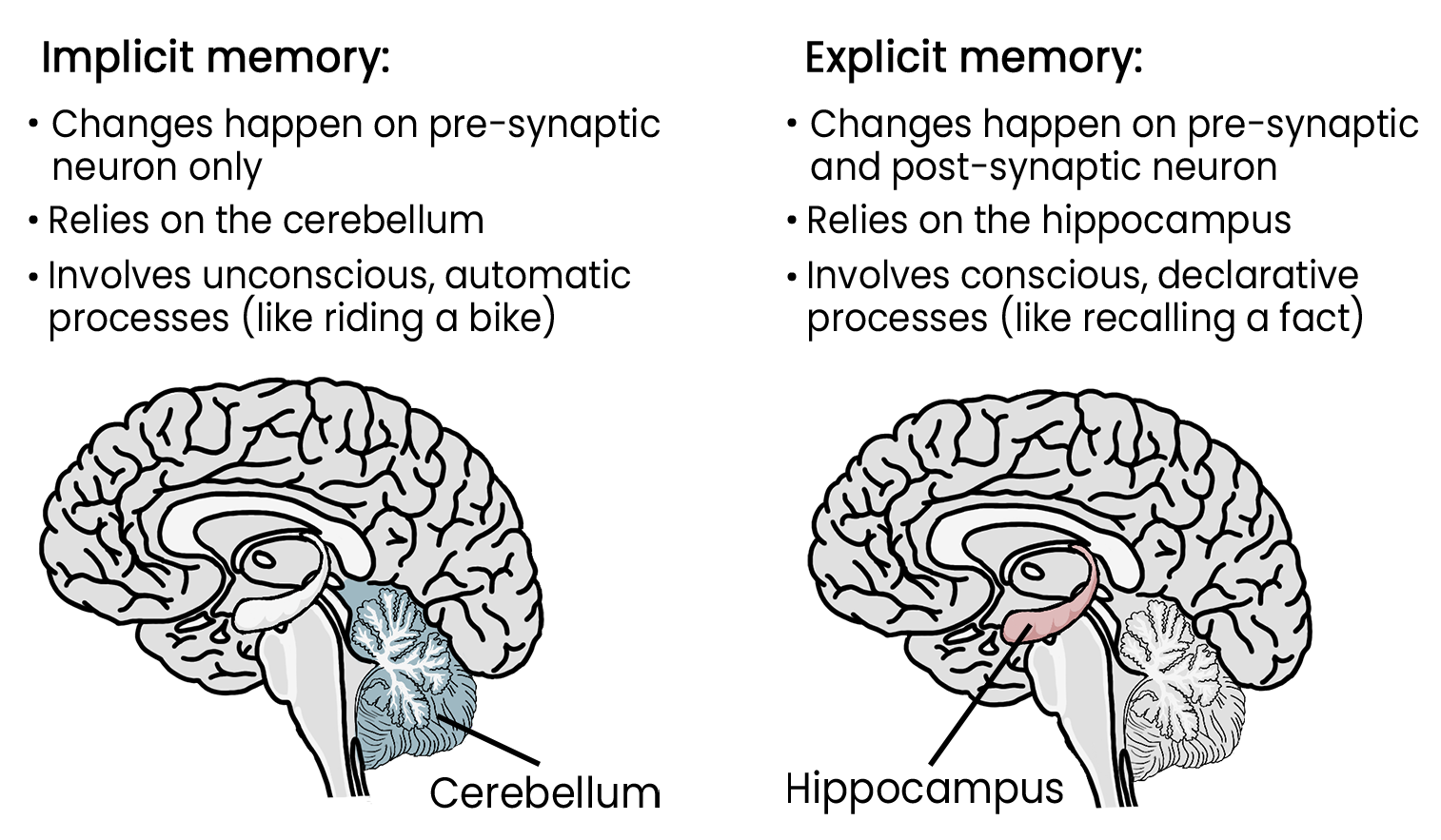
So, to recap: learning and memory aren’t separate processes at all, but two sides of the same system. Simple and associative learning involve the cerebellum portion of the brain and use implicit, short-term memory, whilst complex learning involves the hippocampus and uses explicit, long-term memory. Whether or not learning sticks in our brains is determined by how easily those impulses can travel along our neurons; the stronger the connection, the easier it is to recall.
And that brings this post to a close. If you’ve learned something new along the way, and your memory decides it’s worth hanging onto, then this post has done its job.
Find this topic interesting? Consider checking out the biological enigma of diapause or the recent development in the treatment of heart failure.
Stay curious!
References
Brem, A., Ran, K. and Pascual-leone, A. (2013). Learning and memory. Handbook of Clinical Neurology, [online] 116, pp.693–737. doi:https://doi.org/10.1016/b978-0-444-53497-2.00055-3.
Brown, T., Byrne, J., LaBar, K., LeDoux, J., Lindquist, D., Thompson, R. and Teyler, T. (2004). ‘Learning and Memory: Basic Mechanisms’, in From molecules to networks : an introduction to cellular and molecular neuroscience. [online] Amsterdam ; London: Elsevier Academic Press, pp.499–574. Available at: https://www.sciencedirect.com/science/chapter/edited-volume/abs/pii/B9780121486600500196.
Mayford, M., Siegelbaum, S.A. and Kandel, E.R. (2012). Synapses and Memory Storage. Cold Spring Harbor Perspectives in Biology, [online] 4(6). doi:https://doi.org/10.1101/cshperspect.a005751.